International conference: challenges of minoritized languages in the French-speaking world
2025/11/10
Euskara. Kultura. Mundura.
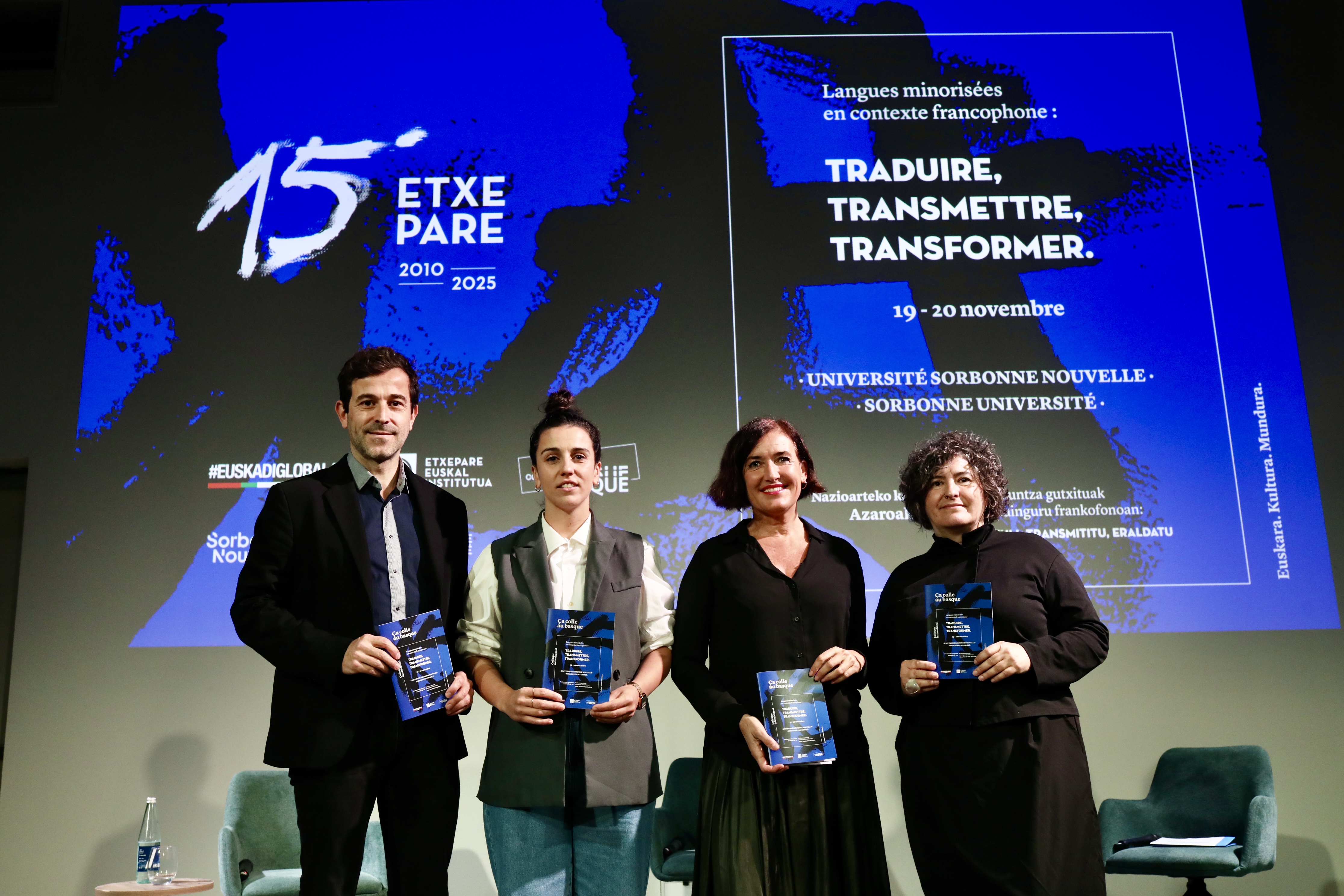
On 19 and 20 November, Sorbonne Université and Université Sorbonne Nouvelle will host an international conference in Paris titled ‘Langues minorisées en contexte francophone: traduire, transmettre, transformer’ (Minoritized languages in a French-speaking context: translating, transmitting, transforming), organised by the Etxepare Basque Institute in collaboration with the two institutions.
The event is part of the Etxepare Basque Institute’s 15th anniversary celebrations and is part of Ça colle au basque, an initiative aimed at boosting the presence of Basque language and creativity in French-speaking countries.
The conference will bring together 20 speakers from nine universities to the academic heart of Paris to address the current challenges facing minoritized languages in the French-speaking world. The conference will focus on and advocate for the social role of languages in diglossic contexts and the importance of linguistic diversity.
With Euskara as its starting point and inspiration, the conference aims to spark a dialogue between minoritized languages coexisting in the French-speaking world. The event will feature three round tables and two keynote speeches focusing on the dynamics of translation, transmission, recognition, and rights of these languages. Internationally renowned professors and specialists in the fields of linguistics, translation, comparative literature, political science, sociology, anthropology and cultural studies will contribute. This will be the first high-level academic forum to place the Basque language at the centre of the debate on minoritized languages in the French-speaking world. It will also address other languages such as the indigenous languages of French Guiana, Antillean Creole, and Breton, among others.
“Holding this conference in the academic heart of Paris has powerful symbolic significance,” explained Etxepare Basque Institute Director Irene Larraza. “It means claiming a place for Euskara in the world of languages and recognising linguistic diversity as a European value. By bringing together languages that are usually marginalised in a single forum, the conference reverses the relationship between the centre and the margins for a few days, placing the social role and relevance of minoritized languages in the spotlight,” she added.
Beyond creating a unique space for reflection and dialogue on linguistic diversity, this conference strengthens the partnership between the Etxepare Basque Institute and two major international academic institutions, Sorbonne Université and Université Sorbonne Nouvelle, where the Institute has been present for more than a decade through its Basque studies programmes.
This meeting marks a significant step forward for the Institute´s academic collaboration, further establishing the presence of the Basque language and Basque studies within the international university community.
Three areas for consideration: translation, transmission and institutionalisation
The conference will feature Euskara as a key subject of study, with around six speakers from both the French and Spanish sides of the Basque Country participating. It will be organised into three main debate sessions, each addressing the major challenges faced by minoritized languages in the French-speaking world.
The first session, dedicated to translation in minoritized languages, will analyse translation policies and practices as tools for linguistic visibility or exclusion. This includes cases like Breton, where many translations serve a symbolic rather than a practical purpose. It also covers the indigenous languages of French Guiana, which, despite being recognized as ´languages of France,´ still lack interpretation and public information services. This absence contributes to social exclusion and weakens citizens´ sense of belonging. The literary translation of Basque into French will also be studied as an example of asymmetry between a minoritized language and a hegemonic language, and the evolution of Euskara as a public issue in the French Basque Country will be addressed.
A second session will address how communities reclaim, transform and transmit their languages and cultural practices. From the Caribbean region, for example, the reappropriation of Antillean Creole will be analysed – how it has transformed from being seen as a ´language of shame´ to becoming a symbol of citizenship and cultural pride. The libertimendua – a form of carnival that has recently reemerged in the French Basse Navarre region – will serve as a case study of cultural renewal in the Basque language. It blends traditional rural carnival rituals with contemporary expressions, becoming a source of collective pride and intergenerational connection.
The third and final session will analyse the contradictions and challenges involved in institutionalising endangered or minoritized languages. For example, the case of Cornish (Cornwall) will be presented, a language that vanished as a daily means of communication in the 18th century but was revived through institutional support. The case of France will also be analysed, where the lack of a legal framework to guarantee the protection and revitalisation of minority languages threatens their survival.
Celebrating the Etxepare Basque Institute’s 15th anniversary in Paris
2025 marks the 15th anniversary of the founding of the Etxepare Basque Institute. The conference is one of the events commemorating this milestone. The main event will take place on 19 November at the Bibliothèque nationale de France, BnF, attended by Basque Prime Minister Imanol Pradales and a broad representation of political, institutional and cultural figures, as well as members of the Parisian Basque diaspora.
The event will be held at the BnF, a venue that holds symbolic significance, as it houses the only extant copy of the first book published in the Basque language, ‘Linguae Vasconum Primitiae’. The author, Bernat Etxepare, not only lends his name to the Institute but also provides its motto, inspiration and mission – Euskara, jalgi hadi mundura (Euskara, go out into the world).
